Call Outs
What happens when the team is called upon?
It all starts with someone calling North Wales Police (NWP) for help - either an individual or another organisation such as the Welsh Ambulance Service. NWP may decide from the initial call that our help is required, or they might conduct their own searches and enquiries first. They then contact our on-call Search Manager.

Our search manager will assess the call-out, formulate an initial plan and send a text alert to all team members to rendezvous as soon as possible at a specified location. Many of our volunteers come straight from work or family commitments. Designated members of the team will collect our control and equipment vehicles en-route.
Search
During a missing person search, our Incident Command Vehicle (ICV) is set up as a mobile base. We use radio and internet-based communication plus alongside specialist computer systems to plan, coordinate, and record an incident at it progresses. A police Search Advisor (PolSA) may join our search operations team in the ICV.
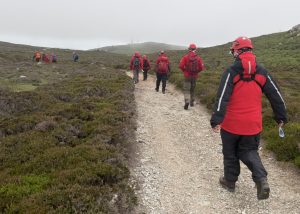
From this base, our qualified volunteers will be organised into parties and commence their search in pre-defined areas identified as significant locations in which the missing person might be.
The teams will continue to search until:
- The missing person is found, or;
- The police call off the search (such as when new information comes in), or;
- The police suspend the search (such as it being unsafe to continue).
In case of suspension, the search may continue when it becomes safe again or resources are obtained to minimise risk.
Rescue
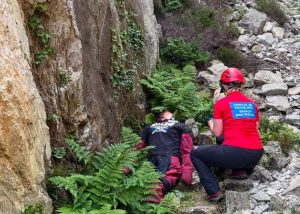
During a rescue operation, we may not require the ICV, instead utilising our 4x4 to transport kit as close to our casualty as possible. From there, we deploy a rapid response team to assess the casualty and report back to base. The information provided is used to determine what additional resources may be required, and to ascertain the safest and most efficient course of action.
A rescue is complete when the casualty is safely in the care of an appropriate service or person - sometimes paramedics, sometimes police, sometimes family and friends.
We may work alongside other services such as:
- Coastguard helicopters
- Welsh Ambulance Service
- Neighbouring SAR teams
We operate in all weather conditions, night or day. All team members are qualified first aiders, and we also have members with a higher level of medical training including registered nurses.
All volunteers are prepared and equipped to operate for up to 8 hours without relief, but it is not unusual for searches to extend beyond that. Very often, the call out comes late in the evening or very early in the morning, once police have exhausted their own enquiries.
The Team have responded to a number of call outs since becoming operational in the summer of 2018. We’ve been able to reunite missing people with their family and friends and, where the outcome was far more sombre, provide closure for their loved ones. Search and Rescue is demanding but incredibly rewarding, and we’re all proud to be part of the team providing a vital service to our community; it’s why we volunteer.
Feedback
Although we don't expect to, we sometimes hear back from people we assist.
We always welcome updates on recovery, and we've received some lovely comments.
"- extremely grateful for the swift response and the number of volunteers who attended during the early hours of the morning."
"- MônSAR Lowland Rescue Team continue to develop and thrive. Feedback from officers at the scene as well as the family involved, highlighted how much your professionalism, dedication, and enthusiasm were appreciated."
Extracts from a letter sent by North Wales Police, following a missing person search in June 2026.